

Hands-on School
on Micro and Nanofabrication
HANDS-ON CLEANROOM ACTIVITIES
Participants can choose from three hands-on laboratory experiences:
During registration, applicants will be invited to indicate their preferred laboratory track.
Each participant will attend one laboratory experience, which will take place over the three afternoon cleanroom sessions.
MEMS-like microcells filled with alkali atomic vapours
as a physical package for miniaturised quantum sensor devices
Quantum technologies are rapidly transforming the way we measure time, magnetic fields, and electromagnetic signals, enabling a new generation of ultra-sensitive and miniaturised devices such as optical clocks, magnetometers, Rydberg sensors, and quantum memories. At the heart of many of these systems are microfabricated vapour cells containing alkali atoms: tiny MEMS-like structures that confine atomic vapours inside millimetre-scale volumes and allow quantum effects to be exploited in compact platforms.
They are generally composed of a glass-silicon-glass 3D structure hermetically sealed by anodic bonding, as illustrated in Figure1. Each microcell includes two cavities dry etched into the silicon layer and connected through microchannels: a dispensing cavity for the introduction of alkali precursors and an optical cavity dedicated to spectroscopic application of the microcell.
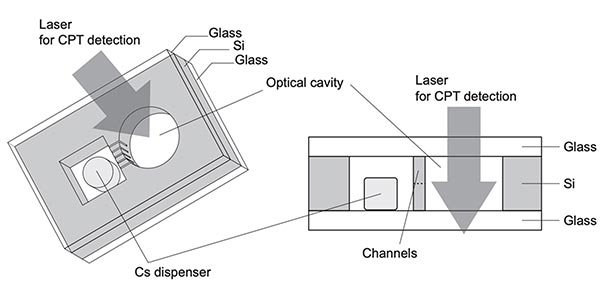
Figure1. Microcell layout and design. From Hasegawa M. et all, Sensors and Actuators A, 2011 ;167, 594-601.
In this hands-on laboratory activity, attendees will explore the complete fabrication workflow of alkali atomic vapour microcells, including photolithography on different layers, deep silicon etching, anodic bonding, and wafer dicing. Along the way, participants will discover how advanced MEMS technologies make it possible to build the physical core of modern quantum sensors.
Beyond the theoretical background, the activity will provide practical insight into fabrication tools, process optimisation, and the technological challenges involved in developing reliable miniaturised quantum devices.
Participants will have the opportunity to observe and discuss real fabrication processes, understand the critical parameters behind each technological step, and gain direct exposure to research topics at the frontier between microengineering and quantum sensing.
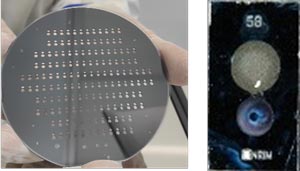
Figure 2. 4 inches fabricated 3D glass-silicon-glass structure with microcell designs and a dicer microcell with precursor activation.
PI: Erik Cerrato (INRiM)
Short Bio: Erik Cerrato received the Master in Material Science in 2016 at the Chemistry Department of the University of Turin where he also got the PhD in Chemistry and Material Science in 2019.
In 2022 he got a permanent position as research technologist for the PiQuET facility at INRIM. The current major research interests are the microfabrication and the spectroscopic characterization of alkali vapor cells for quantum sensing devices.
Fabrication of a multi-electrode array sensing platform
for bioelectric signal detection
Multi-Electrode Arrays (MEAs) are powerful bioelectronic platforms used to investigate how living cells, such as neurons and cardiac cells, communicate through electrical signals. Despite their broad range of applications in neuroscience, pharmacology, and biomedical engineering, their fabrication relies on a set of microfabrication processes that are widely employed across many areas of micro- and nanotechnology. [1]
In this hands-on track, participants will experience the complete development cycle of a microfabricated biosensing device, from the initial design phase to the realization of a functional prototype. Working in the cleanroom environment, participants will design a passive MEA and follow the key fabrication steps required to transform a concept into a device that can potentially be used for recording bioelectrical activity from living cells.
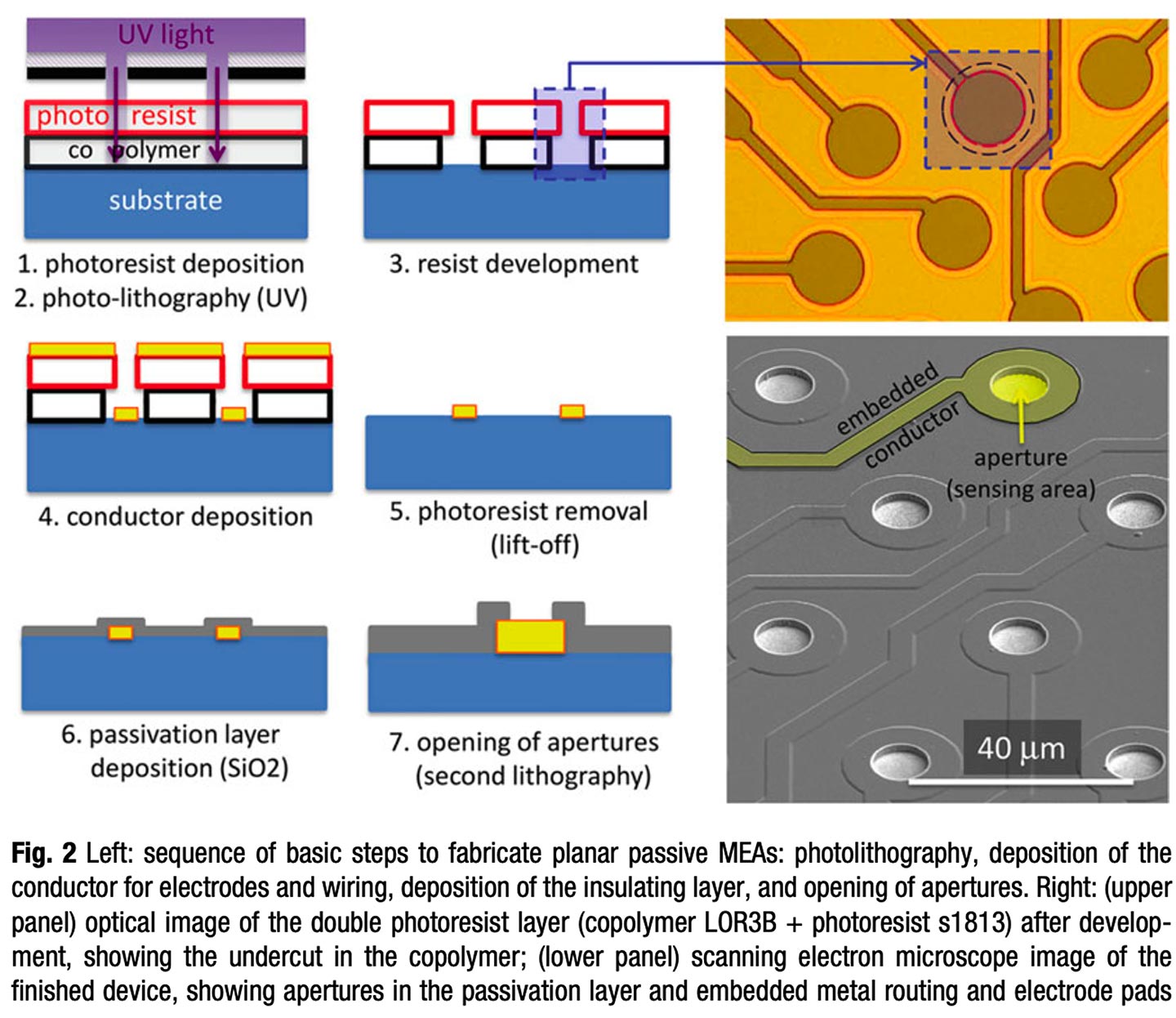
The activity will introduce participants to several fundamental cleanroom technologies, including:
- CAD design of microelectrode layouts;
- Photolithography and pattern transfer;
- Metal deposition and lift-off processes;
- Deposition and patterning of insulating passivation layers;
- Wafer dicing and device assembly.
Throughout the training, participants will gain practical experience with the fabrication workflow typically used for bioelectronic and MEMS devices, learning how each process step influences the final device performance and reliability.
The fabricated platform will include accessible biocompatible sensing spots, conductive routing lines toward a PCB, an insulating passivation layer (SiO2 or Al2O3), and a chamber suitable for future biological experiments. Although cell culture activities are outside the scope of the school, participants will perform electrical testing of the fabricated devices to understand the principles underlying bioelectric signal detection.
By the end of the activity, participants will have acquired a hands-on understanding of the complete fabrication chain of a microsystem for biosensing applications, from design to device realization and preliminary characterization.
[1] M. Malerba et al., Fabrication of Multielectrode Arrays for Neurobiology Applications – https://doi.org/10.1007/978-1-4939-7792-5_12.
PI: Mario Malerba (INRiM)
Short Bio: Mario Malerba, physicist, received a Master in Physics of Advanced Technologies from the University of Torino (2009) and obtained a PhD from the Italian Institute of Technology in Genova (IIT) in 2014.
After working as a researcher in nanobiotechnology, optoelectronics and solid state physics (semiconductors) in Genova (IIT) and Paris (C2N / Université Paris Saclay), he is now a research technologist for the PiQuET facility at INRIM.
Along with supporting and assisting cleanroom users with micro and nanofabrication, today he carries out research mainly on superconducting transition edge sensors (TES) and micromachined ultra-fast optical modulators.
Fabrication of a Lab On a Chip for biomarker detection
Lab-on-Chip devices integrating microfluidics with electrochemical biosensing are emerging as powerful platforms for point-of-care diagnostics, enabling rapid, sensitive detection of disease biomarkers directly from biological samples. At the heart of these systems is the combination of functionalized sensing electrodes with microfluidic channels that allow controlled cell culture and nutrient flow within a single compact chip. They are generally composed of two integrated parts: a sensing module, consisting of metal electrodes patterned through standard microfabrication and subsequently functionalized for biomarker recognition, and a microfluidic module, fabricated from PDMS replicas cast using 3D-printed molds, which defines the channels and chambers for cell growth and nutrient delivery. In this hands-on laboratory activity, attendees will explore the complete fabrication workflow of a Lab-on-Chip biosensing device, including metal evaporation, photolithography and etching for electrode fabrication, 3D printing of microfluidic molds, PDMS replica molding, and final device assembly. Along the way, participants will discover how the integration of microfabrication and soft lithography techniques enables the realization of functional biosensing platforms.
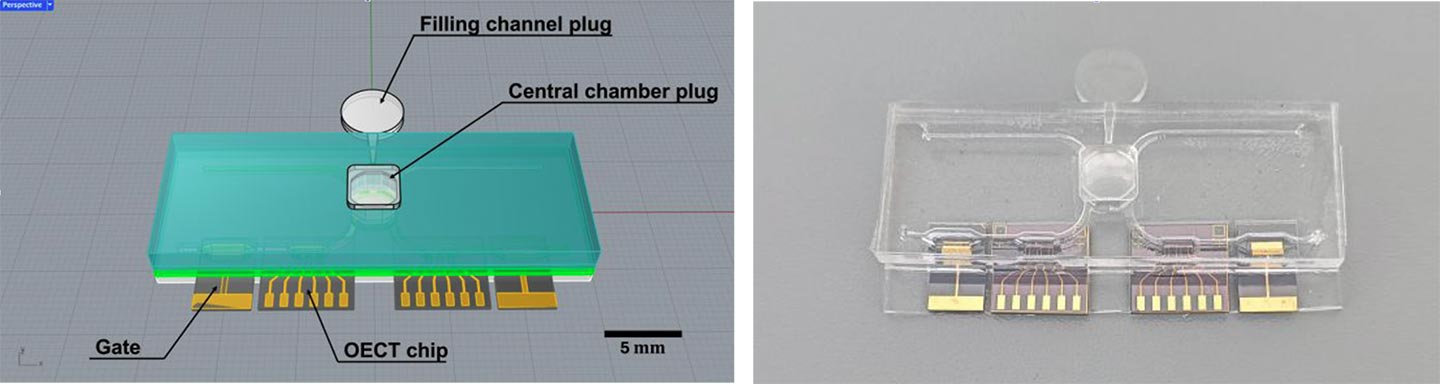
Figure1. Microfluidic device layout and final sample (Lucrezia Regalzi et al., “Lab-On-a-Chip development for barrier model monitoring”, Thesis, Politecnico di Torino).
Beyond the theoretical background, the activity will provide practical insight into fabrication tools, process optimization, and the technological challenges involved in developing reliable Lab-on-Chip devices.
Participants will have the opportunity to observe and discuss real fabrication processes, assemble the different chip components, perform basic electrical testing of the device, and gain direct exposure to research topics at the frontier between microengineering and biosensing.
PI: Alberto Ballesio (PoliTo)
Short Bio: Alberto Ballesio graduated in Nanotechnology for ICTs at the Politecnico di Torino; after that he took a PhD in Electrical, Electronics and Communications Engineering with summa cum laude.
He is an expert in the field of micro and nano device fabrication with more than 7 years of experience in the field. Since his PhD period he worked in one of the Italian most ranked group of micro and nano technology led by C.F. Pirri and is now working specifically on electronic Biosensing. During his career he specialized in all the main cleanroom processes: lithography, evaporation, wet and dry etching, laser writing, as well as microfluidic fabrication. He became an expert in device design and fabrication with a focus on G-FETs and OECTs and their optimization. His network of collaboration is composed by experts in materials science, physics, chemistry, engineering, math. His research has addressed both the fabrication processes of nanoscale devices and their practical implementation in biomedical diagnostics and monitoring systems.
Key Informations

Dates: 27–30 October 2026

Location: Turin, Italy (PiQuET Cleanroom, INRiM as hosting institution)

In-person participants: Maximum 18

Online participation available (morning lectures only)

Language: English
Register
Registration is open until 15th September 2026.
Secure your place and gain practical experience in micro- and nanofabrication within one of Italy’s leading research infrastructures.
Hosting institution
Cleanroom facility





Hosting institution
Cleanroom facility